


.png)


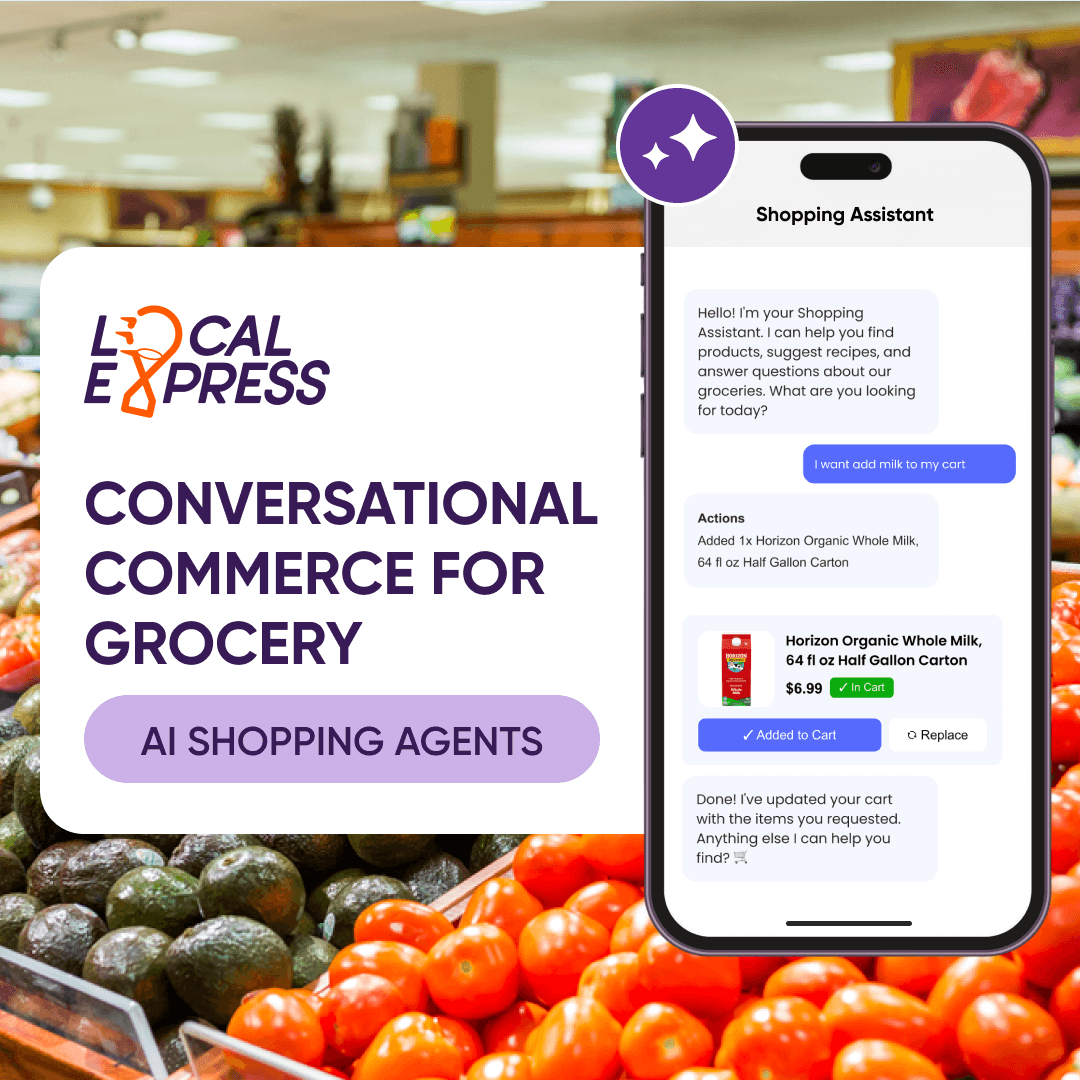



Conversational AI is transforming how consumers shop for groceries, reducing shopping time from 46 minutes to as little as 4 minutes while delivering personalized experiences that drive measurable business results. Food retailers implementing AI-powered shopping agents are seeing 14x increases in add-to-cart rates, higher basket values, and stronger customer retention as they compete with major chains in an increasingly digital marketplace.
Grocery shopping takes the average consumer 46 minutes per trip—time that AI shopping agents can reduce to as little as 4 minutes while helping shoppers make better decisions. Food retailers adopting unified commerce platforms are seeing measurable gains: 14x increases in add-to-cart rates, higher basket values, and customers who return more frequently. For grocers competing against major chains, conversational AI offers a path to match—and often exceed—the digital experience customers expect from the biggest players.
Conversational AI in grocery retail refers to intelligent systems that understand and respond to shoppers using natural language—whether typed or spoken. Unlike traditional search bars that return hundreds of results for "cereal," AI shopping agents interpret nuanced requests like "healthy breakfast cereal for kids with no artificial colors and low sugar" and return precisely matched products.
The shift matters because 85%+ of AI-assisted shopping conversations start with exploratory queries. Customers don't always know exactly what they want—they need guidance. Traditional e-commerce forces them to browse endless category pages, while conversational AI acts as a knowledgeable store associate available 24/7.
Modern AI shopping agents go beyond answering questions. They execute complete shopping tasks autonomously—what the industry calls "agentic commerce." A shopper can say "Plan a week of healthy dinners for a family of four with one vegetarian" and the agent will:
This capability transforms grocery e-commerce from a transactional tool into a service that solves real problems for time-pressed consumers.
The gap between what customers want and what traditional e-commerce delivers creates massive opportunities. When Albertsons deployed their AI shopping assistant, they found customers could complete meal planning and shopping in just 4 minutes versus the typical 46-minute experience.
Traditional grocery search works on keyword matching. Type "pasta" and you get every pasta product in the catalog—often hundreds of results requiring manual filtering. AI shopping agents understand context:
Each query returns targeted recommendations based on the shopper's actual intent, not just matching words.
Personalization engines powering these agents learn from 100B+ data points across shopper behavior, product attributes, and purchase patterns. The result: recommendations that feel genuinely helpful rather than random.
This level of personalization drives measurable results. Retailers using AI-powered recommendations see 14x higher add-to-cart rates compared to generic product carousels.
AI shopping agents benefit more than customers—they transform backend operations for grocers struggling with labor costs and fulfillment complexity.
Modern order management systems enhanced with AI can:
The AI Grocery Data Fusion approach addresses one of grocery's biggest headaches: inconsistent product data. AI automatically harmonizes information from POS systems, supplier catalogs, and manual entries into clean, enriched content that powers better search and recommendations.
Every question an AI agent answers is one your staff doesn't have to handle. Common inquiries easily automated include:
AI-powered substitution systems analyze product attributes, shopper preferences, and purchase history to suggest replacements customers actually want, significantly improving approval rates compared to manual picker choices.
Grocery shoppers increasingly expect retailers to understand their preferences without requiring manual input. AI makes this possible at scale.
Retail media platforms powered by AI deliver personalized promotions based on individual shopping patterns rather than blanket discounts. A family that regularly buys organic produce sees different offers than a household focused on value brands.
Voice and conversational interfaces amplify these benefits. Research shows conversational commerce generates significantly higher average order values than standard website browsing—shoppers engage more deeply when they can simply ask for what they need.
AI shopping agents don't just respond to requests—they anticipate needs. By analyzing purchase history and timing patterns, systems can:
Grocers implementing AI-powered shopping lists have reported substantial improvements in customer retention—proof that predictive personalization builds lasting loyalty.
Fulfillment and delivery represent grocery's biggest operational challenge. AI shopping agents extend their value beyond cart assembly into the logistics of getting orders to customers.
Last-mile delivery management systems enhanced with AI offer:
For grocers, the economics matter. Last-mile delivery typically consumes 40-50% of total fulfillment costs. AI optimization makes home delivery profitable at scale rather than a loss leader.
AI agents keep customers informed throughout the delivery process:
This proactive communication reduces customer service inquiries and builds trust. When issues arise, AI can offer immediate solutions rather than forcing customers to wait for human support.
Conversational AI removes barriers that make grocery shopping difficult for many consumers.
Voice-enabled AI shopping agents help customers who struggle with:
Self-ordering kiosks with ADA and WCAG compliance extend these benefits to in-store shopping, ensuring all customers can access AI-powered assistance regardless of ability.
Modern AI platforms support:
The mission of bringing equality and accessibility to the online grocery market requires technology that works for everyone—not just tech-savvy early adopters.
For grocers evaluating AI shopping agents, integration complexity determines success. The best solutions work with existing infrastructure rather than requiring complete replacement.
Effective AI implementation requires connection to:
Seamless POS integration ensures AI agents recommend products that are actually in stock at correct prices—eliminating the frustration of discovering unavailable items at checkout.
Implementation timelines vary by approach:
Most grocers benefit from starting with API-based enhancements that improve search and recommendations without disrupting current operations. Omnichannel commerce solutions that offer modular AI capabilities allow gradual adoption based on proven results.
Grocers who treat AI as a strategic capability rather than a feature checkbox will define the next decade of food retail.
The concept of "AI-native" retail means building operations around intelligent automation from the ground up. This includes:
Major retailers are already moving in this direction. Instacart's integration with ChatGPT for grocery allows customers to complete purchases entirely within the AI conversation—no switching between apps required.
For grocers competing with major chains, AI shopping agents level the playing field. A well-implemented conversational commerce system can deliver:
The technology exists today. The question is which grocers will implement it effectively.
For food retailers seeking to implement AI shopping agents without the complexity and lock-in of enterprise platforms, LocalExpress offers a compelling path forward.
LocalExpress provides an AI-Native Unified Commerce Platform specifically built for grocery retailers.
Unlike platforms that require grocers to rebuild their entire technology stack, LocalExpress integrates with existing POS systems and offers flexibility to add AI capabilities incrementally. The platform supports mobile apps, web storefronts, and in-store kiosks from a single dashboard—all fully branded to the retailer.
Implementation typically takes just a few weeks, with 24/7 technical support included. For grocers who want to compete with the digital experience of major chains while maintaining their unique brand identity, LocalExpress delivers enterprise-grade AI without enterprise complexity.
AI shopping agents transform grocery from a chore into a guided experience. Instead of browsing hundreds of products, customers describe what they need in natural language and receive targeted recommendations. The technology handles complex requests like meal planning, dietary filtering, and budget optimization—tasks that traditional search cannot perform. Case studies show shopping time reductions from 46 minutes to 4 minutes for AI-assisted sessions.
Retailers gain three primary benefits: increased revenue through higher basket values from conversational commerce, improved operational efficiency through automated customer service and intelligent fulfillment, and stronger customer loyalty through personalization that keeps shoppers returning. The 14x increase in add-to-cart rates from AI recommendations directly impacts bottom-line results.
Yes. Modern AI agents trained on grocery-specific data understand dietary terminology (keto, paleo, low-FODMAP), allergen requirements, and nutritional goals. They can filter entire product catalogs based on these preferences and suggest appropriate substitutions when items are unavailable. The 100B+ data points powering leading platforms enable nuanced understanding of food attributes and shopper needs.
LocalExpress maintains industry-standard data security protocols across all platform components. The system supports retailer data ownership—grocers retain control of customer information rather than surrendering it to third-party aggregators. Integration with existing systems uses secure API connections, and the platform complies with payment processing standards for safe transactions.
Conversational AI is increasingly accessible to grocers of all sizes. API-based solutions allow retailers to enhance existing e-commerce with AI search and recommendations without full platform migration. Implementation costs typically start at accessible monthly rates for add-on services, with setup timelines of 2-6 weeks. LocalExpress specifically targets grocers seeking enterprise capabilities without enterprise complexity, offering quick implementation and flexible integration options.


