


.png)


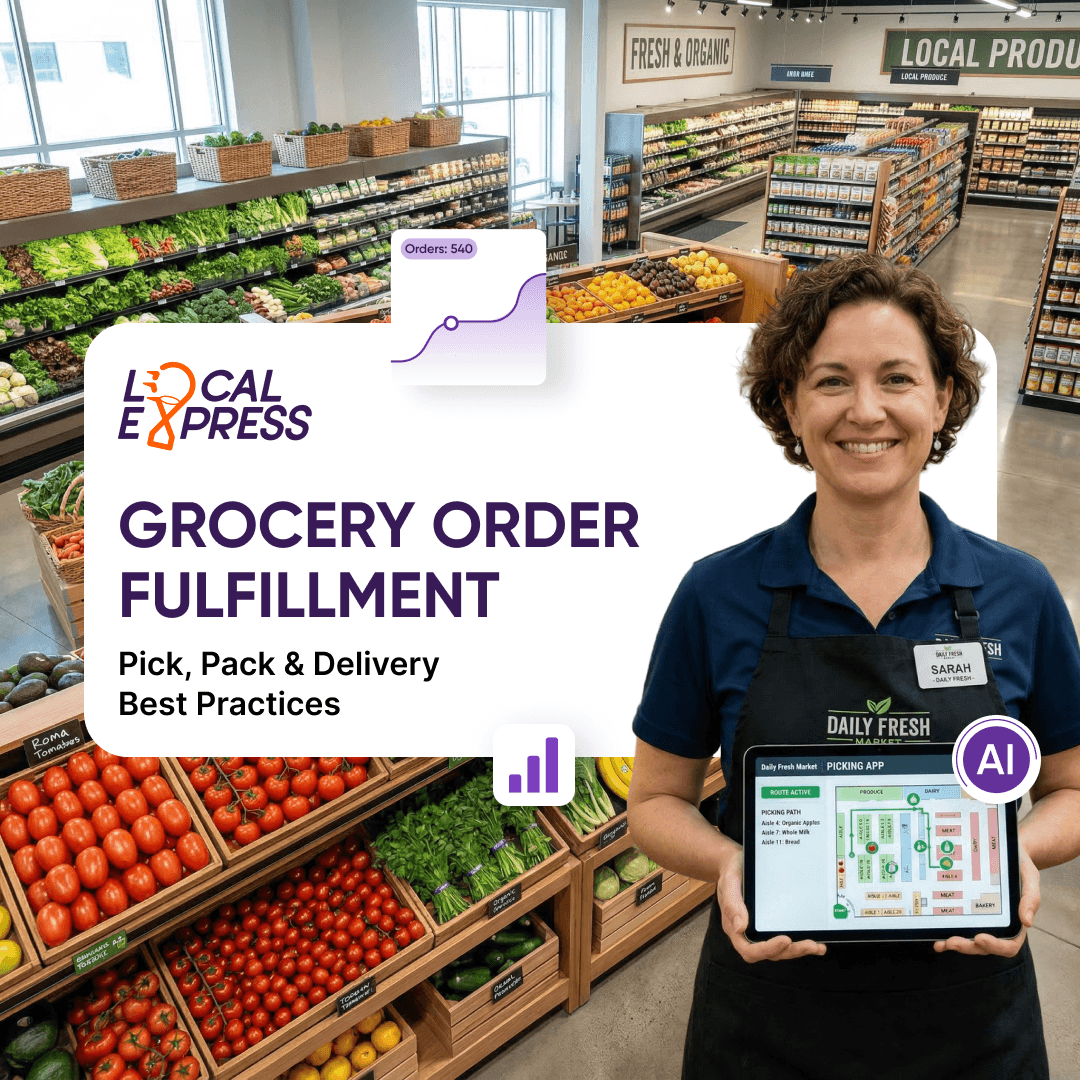



Every unfilled online grocery order costs your business more than the sale itself—it erodes customer trust and pushes shoppers toward competitors. With picking costs alone consuming 55% of operating expenses and last-mile delivery adding another $8 per $100 order, grocers need a unified approach to order management that connects physical stores with digital channels. Grocers mastering these operations aren't just surviving—they're capturing market share in a category projected to grow from $543B to $1.42T by 2029.
The economics of grocery e-commerce are brutal. A typical $100 online order incurs $8 in manual picking costs plus another $8 in last-mile delivery—totaling $16 in fulfillment expenses that obliterate the razor-thin 1-3% margins grocers typically operate on.
This explains why over half of grocers still operate digital channels at a loss. The US online grocery market averages over $10B monthly, representing 4.2% year-over-year growth. Yet growth without profitability is a race to the bottom.
Grocers winning this battle have focused on three core areas:
Your fulfillment center layout directly impacts every order's profitability. Whether you're fulfilling from existing stores or dedicated facilities, the principles remain consistent.
The most impactful change many grocers can make costs nothing: reorganizing product placement based on order frequency. Position your top 100-200 SKUs (which typically represent 60-70% of picks) in the most accessible locations nearest to packing stations.
Key layout considerations include:
Research shows optimizing pick paths can reduce fulfillment time by 30-35% without any capital investment. For a retailer processing 500 daily orders, this translates to significant labor savings.
Modern fulfillment centers require connected systems that provide real-time visibility. Essential technology includes:
An effective inventory management solution should sync seamlessly with your point-of-sale system, providing real-time inventory tracking and predictive stock analysis to prevent stockouts that frustrate customers.
Picking is where fulfillment profitability lives or dies. The difference between a well-optimized picking operation and a poorly designed one can mean profit versus loss on every order.
Several picking methodologies exist, each suited to different operation sizes
Batch Picking allows pickers to gather items for multiple orders simultaneously, dramatically reducing travel time. A picker fulfilling 20 orders in a single pass saves approximately one hour of labor compared to single-order picking.
Zone Picking assigns each picker to a specific store section, passing orders between zones. This works well for larger operations where picker specialization improves speed and accuracy.
Bag-as-You-Go puts items directly into delivery bags during picking, eliminating the separate packing stage entirely. This approach reduces product touches from three to one, cutting handling time by up to two-thirds.
Grocery fulfillment presents unique challenges:
Top-performing operations achieve 98% order accuracy rates through barcode verification at pick stations and quality checks before dispatch.
Customer expectations for grocery delivery continue rising. According to U.S. Census Bureau retail data, e-commerce now represents a significant portion of total retail sales, with 30% of customers expecting same-day delivery while 25% will pay extra for faster options. Meeting these expectations profitably requires strategic fulfillment model selection.
Buy Online, Pick-up In Store has emerged as the most profitable fulfillment model for grocers. By eliminating last-mile delivery costs while maintaining customer convenience, BOPIS offers margin preservation that delivery cannot match.
The numbers support this shift: curbside pickup represents an estimated 31% of online grocery orders versus around 29% for delivery. This reflects customer recognition that pickup often provides faster access to groceries than waiting for delivery windows.
An omnichannel ecommerce solution that seamlessly connects online ordering with in-store pickup helps grocers capitalize on this preference shift while maximizing order profitability.
For orders requiring home delivery, smart scheduling protects margins:
The last mile represents the final—and often most expensive—touchpoint with your customer. According to Bureau of Transportation Statistics, 29% of truck miles run empty on average across the industry, representing massive inefficiency.
AI-powered routing can reduce delivery time by 18-35% during peak periods through:
A comprehensive last-mile delivery platform should integrate with multiple delivery networks—connecting to providers like DoorDash, Uber, and over 100 others through a single integration point—while providing centralized control and store-level flexibility.
The choice between owned fleets, third-party delivery partners, or hybrid models impacts both costs and customer experience:
Owned Fleet Advantages:
Third-Party Advantages:
Most successful grocers employ hybrid models, using owned vehicles for predictable base volume while tapping third-party networks for peaks.
The technology gap between leading grocers and laggards continues widening. AI and automation are now the foundation of profitable operations.
Compact automated facilities of 3,000-10,000 square feet can process 1,000-4,000 orders weekly at speeds impossible to achieve manually. These micro-fulfillment centers achieve 400-500 units per hour compared to 60-70 UPH for manual picking—a 5x improvement.
Big retailers like Walmart have positioned MFCs within 10 miles of 90% of US customers, enabling profitable 2-hour delivery windows.
Artificial intelligence applications span the entire fulfillment operation:
According to industry experts, retailers implementing AI solutions can achieve productivity gains of up to 40% across their operations.
Fragmented systems create data silos that prevent optimization. Grocers achieving profitability have connected their technology stacks into unified platforms.
Effective fulfillment requires real-time data flow between:
Charlie Kaplan, Chief Product Officer at Wynshop, emphasizes: "Order picking and fulfillment efficiency remain the biggest challenges for most digital grocery operations. Having the right technology tools and data-based strategies to overcome these challenges is a precondition for profitability."
Product data inconsistencies between systems create operational chaos. When your POS calls an item "2% Milk 1 Gal" but your e-commerce platform lists "1 Gallon 2% Reduced Fat Milk," pickers waste time reconciling differences.
An AI-powered data fusion solution can harmonize product catalogs across systems, turning raw data into clean content that accelerates store onboarding and maintains real-time inventory accuracy.
For grocers seeking to transform their fulfillment operations without building complex technology stacks from scratch, LocalExpress offers an AI-native unified commerce platform purpose-built for food retailers.
The platform addresses the core challenges covered in this article:
AI-Powered Order Fulfillment: LocalExpress's order management system accelerates fulfillment by 50% through AI-powered store mapping that organizes collection by aisle, department, or zones. The platform handles multi-order batch fulfillment while maintaining high accuracy through intelligent product substitution recommendations.
Integrated Last-Mile Delivery: The last-mile delivery platform connects to DoorDash, Uber, Nash, and 100+ delivery networks through a single integration. AI-powered routing optimizes delivery efficiency while the driver app provides route optimization and proof of delivery.
Seamless POS Integration: Real-time synchronization between your point-of-sale system and online channels eliminates inventory discrepancies that frustrate customers. The platform supports major POS systems including NCR, Toshiba, and IT Retail.
Omnichannel Flexibility: Whether customers choose delivery, curbside pickup, or in-store shopping, LocalExpress's unified platform provides consistent experiences while maintaining brand identity—grocers own their customer relationships and data.
Implementation typically takes 4-8 weeks with 24/7 technical support, compared to 2+ months for competing solutions. For grocers ready to move from losing money on digital orders to profitable e-commerce operations, LocalExpress provides the connected systems and AI-powered automation that make the difference.
Order fulfillment encompasses the entire process from receiving an order through delivery to the customer. Pick and pack refers specifically to warehouse operations: selecting items from inventory (picking) and preparing them for shipment (packing). Pick and pack is a critical subset where 55% of fulfillment costs concentrate, making it the highest-leverage area for optimization.
AI applications span multiple fulfillment areas. Predictive analytics can reduce stockouts by 15-20% by forecasting demand before you run out. Route optimization algorithms improve on-time delivery while reducing travel time. AI-powered picking systems optimize pick paths and batch orders for efficiency. Combined, these applications can deliver productivity improvements of up to 40% across operations.
The biggest challenge is cost—last-mile delivery adds approximately $8 to a $100 order, which exceeds typical grocery margins. Other challenges include maintaining cold chain integrity for perishables, managing customer time-window expectations, and handling the 29% empty miles that waste fuel and driver time. Successful grocers address these through hybrid fleet models, AI route optimization, and strategic BOPIS promotion.
Poor inventory accuracy creates cascading problems: customers order items that aren't actually available, forcing substitutions, with 2.1% of items substituted in digital orders. This damages trust and increases service recovery costs. The solution lies in real-time POS integration that syncs inventory across all channels, preventing overselling and stock discrepancies.
BOPIS (Buy Online, Pick-up In Store) represents an estimated 31% of online grocery orders versus around 29% for delivery because it offers advantages for both customers and grocers. Customers often get their groceries faster through pickup than waiting for a delivery window, while avoiding delivery fees. For grocers, BOPIS eliminates the $8 per-order last-mile cost that destroys margins on home delivery, creating a fulfillment method that satisfies customers while preserving profitability.


