


.png)


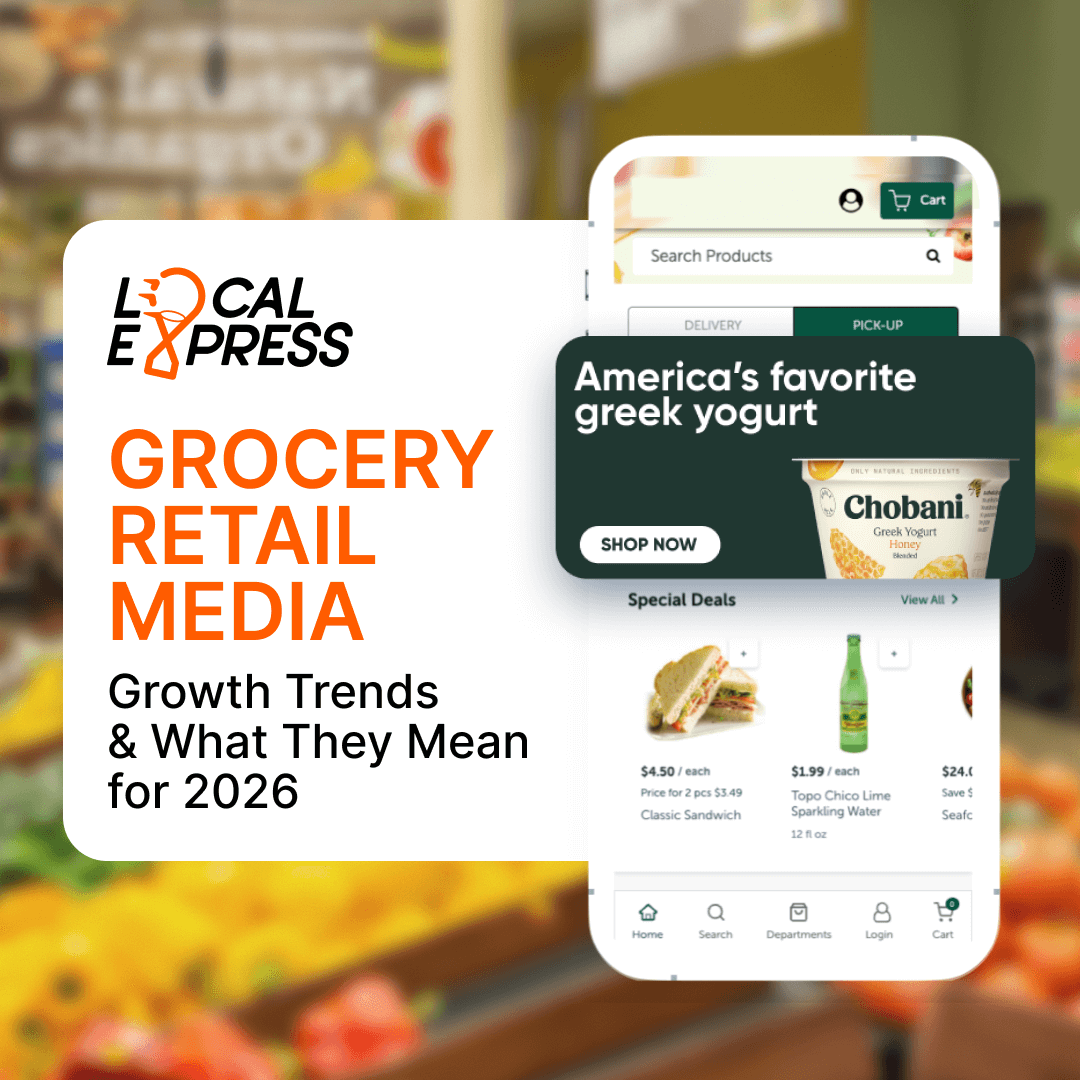



Comprehensive analysis of 23 key statistics shaping the future of retail media networks and CPG advertising for independent grocers and regional chains
Industry forecasts from Insider Intelligence project retail media ad spending will reach $54.85 billion in the United States in 2026, representing significant year-over-year acceleration and demonstrating sustained advertiser confidence in retail media as an effective channel for reaching consumers. For independent grocers and regional chains, this growth trajectory validates investment in retail media infrastructure and creates opportunities to capture meaningful advertising revenue that can improve overall business profitability. Source: eMarketer
Projections indicate that total U.S. retail media ad spend will surpass $100 billion by 2028, representing nearly one-fifth of all U.S. digital ad spending by that time. This trajectory positions retail media as a fundamental component of the advertising ecosystem rather than a niche channel, creating both opportunities and competitive imperatives for grocery retailers of all sizes. Grocers implementing retail media CPG platforms that deliver personalized advertising across mobile apps, kiosks, and websites can capture meaningful shares of this expanding market. Source: eMarketer.
Off-site retail media ad spend—advertising placements on social media platforms, connected TV networks, premium publishers, and other digital properties outside retailer-owned ecosystems—is growing substantially faster than on-site placements. This differential growth rate reflects both the maturation of on-site inventory and the enormous scale opportunities available through off-site channels, where retailers leverage first-party data to reach consumers across the open web and streaming video platforms. Source: Crealytics
Research from Harvard Business Review demonstrates that customers who engage with retailers across multiple channels—including in-store visits, retailer websites, mobile apps, and other touchpoints—exhibit substantially higher lifetime value than single-channel shoppers. This spending premium reflects higher engagement levels and more frequent purchases when consumers can interact with retailers through their preferred channels. Grocers implementing comprehensive omnichannel solutions capture both the direct revenue premium and enhanced retail media inventory across web, mobile, and in-store touchpoints. Source: Harvard Business Review.
Current industry analysis indicates that approximately 88 percent of grocery sales still occur in-store, proving that brick-and-mortar retail remains the cornerstone of the grocery industry and revealing the enormous untapped opportunity for in-store retail media. This statistic underscores why solutions like self-ordering kiosk systems and in-store digital displays represent critical infrastructure for retail media success, since the vast majority of transactions occur in physical locations where digital advertising technologies can influence purchase decisions. Source: McKinsey
Monthly e-grocery household penetration has grown substantially in recent years, with tens of millions of U.S. households now regularly purchasing groceries online. This penetration creates extensive digital inventory for retail media placements including sponsored products, display banners, and personalized promotions delivered through branded grocery eCommerce platforms. The combination of growing penetration and increasing transaction frequency positions online grocery as a premium advertising channel for CPG brands. Source: Grocery Dive
The phasing out of third-party cookies has intensified focus on first-party data, with 90 percent of marketers identifying first-party data as a critical priority according to IAB research. This shift has created enormous competitive advantage for retailers possessing direct relationships with hundreds of millions of consumers and decades of transaction history. For independent grocers, loyalty programs integrated with POS systems and eCommerce platforms generate the first-party data foundation required to monetize retail media opportunities. Source: Think with Google
Industry research from McKinsey demonstrates that the majority of grocery executives have identified media monetization as a strategic priority, reflecting recognition across the industry of the financial opportunity represented by retail media networks. This executive-level commitment accelerates retail media investments and creates competitive pressure for grocers of all sizes to develop advertising capabilities. The widespread adoption of partnership models enables this prioritization even among smaller grocers. Source: McKinsey
Industry analysis indicates that in-store retail media deployments are accelerating significantly, with grocers rapidly adopting digital signage and other in-store media technologies. This wave of deployment creates immediate opportunities for grocers with physical locations to monetize their store environments through self-ordering kiosks, digital displays, and shelf-edge technology. Early-mover grocers in their markets gain first-to-market advantages in capturing CPG advertising budgets. Source: Adsmurai
By 2029, ad spending on in-store retail media is projected to exceed the $1 billion threshold, indicating substantial growth potential from current levels and validating investment in in-store digital infrastructure. For independent grocers operating physical stores, this represents an opportunity to monetize existing foot traffic through digital screens, interactive kiosks, and audio advertising systems that deliver targeted messages to consumers making active purchasing decisions. Kiosk solutions that accept multiple payment options and collect detailed customer preference data maximize this monetization opportunity. Source: eMarketer
Connected television retail media ad spending is experiencing strong year-over-year growth, with spending projected to reach several billion dollars in 2026, highlighting advertiser appetite for video-based strategies that extend retail media beyond the point of purchase. While independent grocers may not directly operate CTV inventory, this demonstrates CPG budget allocation patterns and validates comprehensive retail media strategies that blend in-store, online, and broader digital channels. Grocers partnering with platforms offering marketplace integrations can participate in these expanded media opportunities. Source: OEMAD
Amazon's advertising services revenue reached $54.5 billion in 2024, representing substantial year-over-year growth according to company financial disclosures. This dominance reflects Amazon's combination of consumer purchase data, extraordinary traffic volumes, and sophisticated advertising technology developed over more than a decade. While Amazon's scale creates competitive challenges, it also validates the retail media business model and demonstrates the revenue potential for grocers who successfully implement retail media capabilities appropriate to their scale. Source: Campaign
Amazon commands the leading share of U.S. retail media ad spending, though its dominance faces growing competition from Walmart and other retailers expanding their advertising businesses. This market position demonstrates Amazon's sustained strength in online retail media channels while revealing that substantial portions of retail media budgets flow to other platforms. Independent grocers can capture meaningful shares of non-Amazon spend through differentiated offerings focused on local engagement and personalized service. Source: PYMNTS
Walmart reported that Walmart Connect generated $4.3 billion in revenue in fiscal year 2026, demonstrating substantial year-over-year growth according to company disclosures. These figures demonstrate that while Amazon remains dominant, Walmart has built a substantial and rapidly growing advertising business extending across multiple channels. This success validates the opportunity for large-scale retailers to compete effectively in retail media beyond Amazon's digital dominance. Source: Walmart
In the U.S. market, Amazon and Walmart combined command the majority of retail media budgets, with their combined share representing well over half of total spending according to industry forecasts. This concentration reflects enormous scale advantages in terms of consumer traffic, data availability, and technology capabilities. However, outside these two dominant players, significant opportunities exist for regional and specialty grocers to develop meaningful retail media businesses, particularly through partnerships with technology vendors enabling rapid scaling without massive capital investment. Source: PYMNTS
Kroger Precision Marketing campaigns have consistently delivered strong returns on ad spend, with agencies and brands reporting measurable performance improvements. This performance demonstrates that traditional grocery chains with strong loyalty programs and comprehensive first-party data can compete effectively in retail media and deliver measurable value to CPG advertisers. The returns validate investment in retail media infrastructure and demonstrate that advertisers will pay premium CPMs for high-quality, targetable grocery audiences. Source: Kroger Precision Marketing
Target's Roundel retail media business has demonstrated exceptional growth, delivering substantial value for Target with significant increases in sponsored product ad placements. Roundel now works with over 2,000 vendors and has expanded beyond Target's owned properties to include advertising placements on premium publishers. This expansion demonstrates how retail media networks can extend beyond owned-and-operated properties to create comprehensive advertising ecosystems. Source: Target
The majority of digital advertisers plan to increase their retail media budgets in 2026, demonstrating sustained confidence in the channel and creating expanding revenue opportunities for grocers with retail media capabilities according to IAB research. This planned increase validates strategic investments in retail media infrastructure and suggests that early-mover grocers can capture disproportionate shares of growing advertiser budgets. Most digital advertisers have already allocated budget for retail media, indicating broad mainstream adoption beyond early-adopter brands. Source: IAB
Industry analysis from McKinsey indicates that most retail media growth represents budget reallocation from less measurable channels like traditional television, programmatic display, and other digital channels rather than entirely new advertising investment. This reallocation dynamic has profound implications for retail media growth rates in coming years, as the available budget pool represents a finite resource being redistributed. Grocers must demonstrate clear ROI to capture their share of this competitive budget environment. Source: McKinsey
Consumer packaged goods total media ad spending growth remains in the low-to-mid single digits, slightly below broader advertising market growth rates according to industry analysis. However, within this constrained overall budget growth, retail media has become one of the fastest-growing channels, pulling incremental budget share from traditional search, programmatic display, and trade marketing investments. This competitive dynamic favors retail media networks demonstrating measurable sales lift and transparent attribution. Source: Oberlo
Industry directories track over 200 retail media networks operating globally, with more than 150 networks in the United States alone, creating an increasingly complex ecosystem that brands must navigate. This proliferation creates challenges for advertisers managing multiple platforms with different rules, measurement methodologies, and technical implementations. For smaller grocers, this fragmentation validates partnership with established platforms rather than building proprietary systems, since brands prefer consolidated access rather than managing hundreds of unique vendor relationships. Source: Flipflow
IAB research indicates that a significant portion of brands express concerns about transparency in how retail media partners use emerging tools like artificial intelligence, reflecting broader industry apprehension about algorithmic decision-making and data usage within retail media networks. This concern creates opportunities for grocers emphasizing transparency, ethical data practices, and clear explanations of how AI enhances targeting without compromising consumer privacy. Platforms offering white-labeled customer experiences and complete data ownership address these transparency concerns while enabling sophisticated personalization. Source: IAB
Retail media growth is driven by three converging forces: the deprecation of third-party cookies making retailers' first-party data uniquely valuable, CPG brands reallocating budgets toward measurable channels with closed-loop attribution, and grocers recognizing media monetization as a high-margin revenue stream. With the majority of marketers citing first-party data as critical and retail media spending projected to reach nearly $55 billion in 2026, this represents a fundamental industry transformation rather than a temporary trend.
While Amazon and Walmart command the majority of retail media budgets through scale advantages, independent grocers possess unique competitive strengths including superior local market knowledge, loyal customer bases, and the ability to integrate in-store and digital advertising touchpoints. The shift toward partnership models has democratized access to sophisticated retail media technology, enabling independent grocers to launch advertising platforms without massive IT investments through white-label solutions.
Successful retail media requires unified first-party data from POS systems, loyalty programs, and eCommerce platforms; digital advertising inventory across web, mobile app, and in-store kiosks; campaign management and reporting tools for CPG partners; and closed-loop measurement connecting advertising to actual sales. Rather than building these capabilities in-house, most grocers now partner with platform providers offering turnkey retail media solutions with integrated POS synchronization and multi-channel advertising delivery.
With approximately 88% of grocery sales still occurring in physical stores and in-store retail media deployments accelerating rapidly, in-store represents a massive untapped opportunity. In-store retail media spending is projected to exceed $1 billion by 2029, with solutions like self-ordering kiosks, digital signage, and mobile app integration enabling grocers to monetize high-frequency store visits and influence purchase decisions at the point of sale.
AI enables true one-to-one personalization at scale, creating individually tailored offers based on purchase history, basket composition, and behavioral patterns rather than segment-based targeting. Advanced platforms use predictive AI to optimize campaign incrementality and automate creative variations. Grocers deploying AI-powered data fusion and personalization capabilities gain competitive advantages in targeting precision and campaign effectiveness, though transparency remains critical to addressing advertiser concerns.


