


.png)


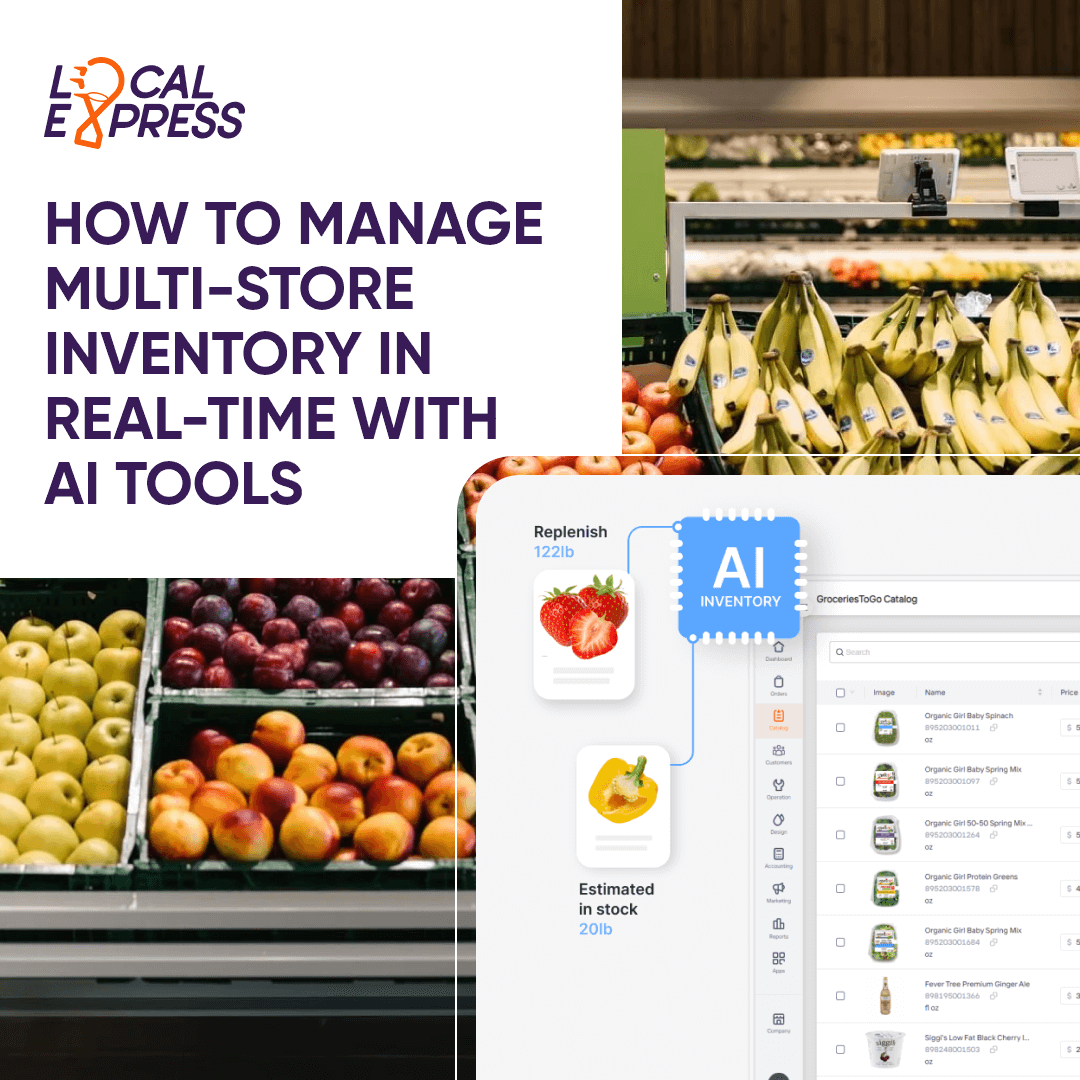


AI-powered inventory management transforms how grocery retailers coordinate stock across multiple locations, eliminating the manual coordination that creates costly mismatches. When one store runs out of high-demand items while another marks down excess inventory, retailers lose revenue on both ends. Modern AI platforms now deliver real-time synchronization, predictive demand forecasting, and automated replenishment across entire retail networks—achieving forecast accuracy often reaching 85-95% compared to traditional manual methods. These systems connect disparate POS systems, warehouses, and sales channels into unified platforms that optimize stock levels dynamically, reduce fresh product waste through shelf-life prediction, and enable the omnichannel fulfillment that today's grocery shoppers expect. For multi-location retailers, implementation typically delivers measurable ROI within months while cutting carrying costs and positioning operations for sustained competitive advantage.
Every grocery retailer with multiple locations faces the same challenge: stock imbalances that drain profits silently. When your flagship store runs out of a top-selling item while your suburban location marks down excess inventory, you're losing money on both ends—missed sales at one store, shrinkage at another.
The financial impact compounds quickly. Regional grocery chains with 20+ stores can lose hundreds of thousands of dollars annually to inventory mismatches alone. For perishables, the stakes are even higher. Fresh produce departments experience significant shrinkage when ordering relies on manual estimation and ""gut feel"" rather than data-driven prediction.
The root problem isn't poor staff performance—it's the structural impossibility of manually coordinating inventory across dozens of locations with thousands of SKUs. Traditional methods simply can't process the volume of data required to optimize stock levels in real-time across an entire retail network.
Manual inventory management creates predictable failure points that grow more severe as your operation scales:
When your buyers juggle purchase orders, supplier negotiations, and inventory monitoring across multiple locations, errors become inevitable. The complexity overwhelms human capacity—not because staff aren't capable, but because the data volume exceeds what manual processes can handle.
Modern AI inventory platforms function as a central nervous system connecting all your stores in real-time. They analyze historical sales, external factors, and current stock positions to automate decisions that previously required hours of manual work.
AI systems track inventory across every store, warehouse, and online channel with immediate updates when stock moves. Key capabilities include:
This real-time synchronization enables grocers to significantly reduce emergency transfers between stores while maintaining service levels with an estimated 15-25% less total network inventory.
AI forecasting analyzes 12-36 months of sales history combined with external signals to predict demand at granular levels. The system considers:
Dynamic reorder points replace static thresholds, adjusting automatically as conditions change. Purchase orders are generated when stock is projected to hit reorder levels within the lead time window—reducing stockouts by 90-95% while preventing excess inventory buildup.
Grocery-specific AI platforms include specialized algorithms for fresh and ultra-fresh products that factor:
Grocers using these fresh-focused systems report up to 50% reduction in overstocks while improving product availability by 10-15%.
The foundation of real-time inventory management is seamless connectivity between your POS systems and the AI platform. Without this integration, data flows in batches rather than instantly—creating the lag that leads to overselling and stock discrepancies.
Modern omnichannel eCommerce solutions connect with major POS providers through pre-built integrations:
Effective POS integration eliminates the price inconsistencies that frustrate customers and create operational headaches. When a promotion runs in-store, online pricing updates automatically. When online orders deplete stock, store inventory reflects the change immediately.
For grocers running legacy POS systems, middleware solutions bridge the gap. While custom integration may require $10,000 to over $250,000 in development depending on complexity, the payback comes quickly through reduced manual reconciliation and fewer stock errors.
AI inventory platforms extend beyond desktop dashboards to mobile apps that enable on-the-go management throughout your stores. Staff can:
Support for barcode scanners and Zebra devices streamlines receiving and cycle counting. Rather than paper-based processes that require manual data entry, scanned items update inventory instantly across all connected systems.
Cloud-based access means buyers can review stock positions, approve purchase orders, and monitor alerts from home or while traveling. The flexibility proves especially valuable during peak seasons when decisions can't wait for someone to reach a desktop computer.
Accurate inventory data powers efficient order management across all fulfillment channels. AI systems connect real-time stock positions to picking, packing, and delivery operations.
These capabilities enable grocers to accelerate fulfillment significantly compared to traditional methods. Pickers spend less time walking and searching, more time filling orders.
Real-time inventory visibility prevents the overselling that damages customer trust. When stock runs low, the system automatically adjusts availability across channels before orders are placed for items you can't fulfill.
For grocers managing delivery operations, AI-powered last-mile delivery cuts costs through intelligent routing and third-party network integration.
Multi-store grocers struggle with inconsistent product data across locations and systems. Different SKU names, incomplete attributes, and conflicting categories create downstream problems in forecasting, ordering, and customer experience.
Clean, consistent data can significantly improve forecast accuracy because the AI system can properly analyze patterns across your entire network rather than treating each store's slightly different data as separate products.
The onboarding benefits prove substantial as well. New store launches that previously required weeks of manual data cleanup can complete in days when AI handles the harmonization automatically.
Grocers expanding to marketplaces like Instacart and DoorDash face additional inventory complexity. Each platform requires catalog management, stock updates, and order synchronization—multiplying the coordination burden.
Rather than managing each marketplace separately, grocers control all channels from a unified platform. When stock changes at any location, all connected marketplaces update within minutes.
Successful AI inventory deployment follows a phased approach that builds confidence while minimizing risk:
Most grocers achieve positive ROI within 90-180 days of deployment, with the AI system improving substantially in accuracy during the first year through continuous learning.
AI inventory management delivers measurable returns across multiple dimensions:
Grocery retailers implementing AI-powered inventory management can expect substantial annual savings from inventory reduction, labor efficiency, and waste prevention combined.
LocalExpress provides an AI-powered unified platform purpose-built for food retailers seeking real-time multi-store inventory control without the complexity of cobbling together multiple point solutions.
LocalExpress integrates with major POS systems including NCR, Toshiba, and IT Retail through 1-click sync. Real-time inventory tracking, predictive stock analysis, and low stock alerts work together to prevent overselling and stock discrepancies across all your channels.
The platform's AI Data Fusion module harmonizes product information from multiple sources, enriching your catalog automatically while maintaining real-time accuracy across locations. New store onboarding accelerates dramatically when AI handles data cleanup.
From branded e-commerce and mobile apps to self-ordering kiosks and marketplace integration, LocalExpress connects all your sales channels through a centralized management dashboard. Inventory updates once and reflects everywhere—eliminating the manual coordination that creates errors.
AI-powered order management accelerates picking through store mapping integration while the platform's delivery management capabilities cut last-mile costs through intelligent routing and 100+ delivery network integrations.
LocalExpress offers 24/7 technical support and implementation guidance, with typical deployment completing in just a few weeks. For grocers ready to transform multi-store inventory management, the platform delivers enterprise-grade capabilities while preserving your unique brand identity.
Most grocers complete pilot programs in 4-8 weeks focusing on high-volume SKUs or a single product category. Full enterprise deployment typically takes 6-12 months depending on the number of locations and integration complexity. Platforms with pre-built POS connectors significantly reduce implementation time. LocalExpress offers a quick setup with dedicated support.
Yes, grocery-specific AI platforms include specialized handling for weighted and variable-priced items. The systems manage catch-weight products, track by unit or pound depending on product type, and sync this information across POS and e-commerce channels. LocalExpress supports variable items for butcher shops, delis, and produce departments.
AI inventory systems perform best with 12-24 months of sales history to capture seasonal patterns and annual trends. However, systems can begin generating useful forecasts with as little as 3-6 months of data, using attribute-based predictions and industry benchmarks to fill gaps. Accuracy improves continuously as more data accumulates.
Modern platforms connect through pre-built integrations, APIs, or middleware depending on your systems. Real-time sync with major POS providers like NCR, Toshiba, and Square is typically straightforward. Legacy systems may require custom integration work. LocalExpress provides flexible integration options with comprehensive technical support.
Most implementations achieve positive ROI within 90-180 days through combined savings from reduced stockouts, lower carrying costs, decreased waste, and labor efficiency gains. The AI system continues improving over time, with most platforms delivering substantially better performance after the first year of continuous learning."


