


.png)





Grocery retailers face a fundamental challenge: thin margins of 1-3% leave little room for error while big retailers capture an outsized share of CPG advertising budgets. Retail media networks offer a solution—transforming your existing digital properties and customer data into high-margin revenue streams. With the grocery retail media market projected to reach $8.5 billion in 2024, grocers who connect their e-commerce platforms, mobile apps, and in-store systems through AI-powered unified platforms can compete for advertising dollars that previously flowed exclusively to Amazon and Walmart.
Retail media networks represent advertising infrastructure where grocery retailers monetize their digital and physical properties by selling ad space to CPG brands. Unlike traditional grocery retail margins, retail media generates high-margin revenue by monetizing existing shopper traffic and first-party data without increasing operational complexity or raising product prices.
The financial impact is substantial. According to industry research, grocers expect 13% revenue growth from retail media, with projections suggesting the market could double within 18 months. This represents a strategic shift where grocers become media companies, offering brands advertising opportunities across owned digital properties, in-store displays, and extended networks.
The opportunity exists because grocery shoppers visit stores frequently with high purchase intent, creating touchpoints that third-party advertising platforms cannot match. As Deborah Weinswig, CEO of Coresight Research, explains: "Retail media networks put more information into the hands of consumers so they can make educated decisions. The consumer wins, the retailer wins and the brand wins."
Successful grocery retail media networks operate across three integrated channels:
Research shows 87% of grocers believe tying digital channels and stores together is critical for media monetization success. Yet 86% report completely siloed or only partially integrated systems—creating a significant implementation gap.
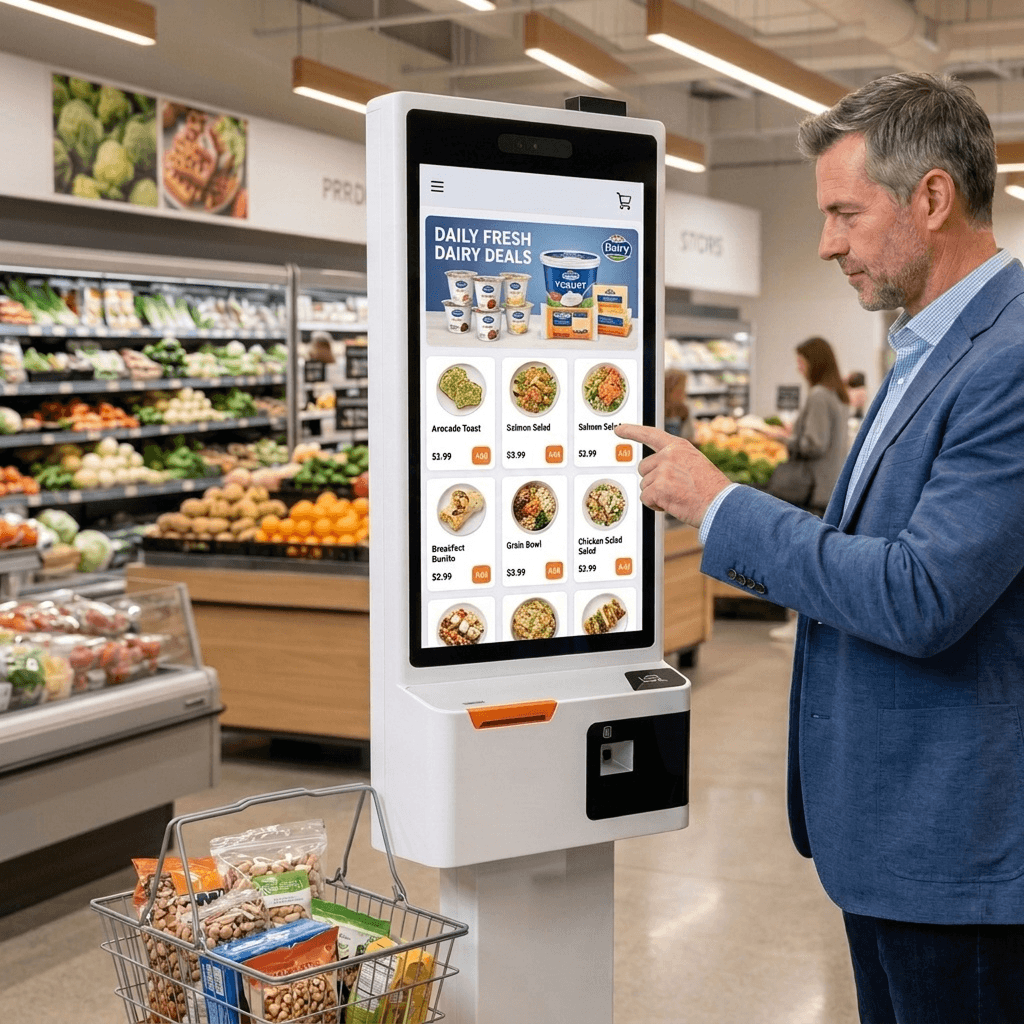
In-app advertising through a branded mobile app allows grocers to showcase CPG brand products with personalized offers delivered directly to shoppers' devices. Similarly, self-ordering kiosk systems provide high-visibility digital displays at critical decision points within the store. The revenue potential is clear: grocers earn from CPG brands paying to advertise across their digital properties while maintaining complete control over customer experience.
AI-powered advertising delivers superior results by matching the right products with the right shoppers at the right moment. Rather than showing generic promotions to all customers, AI analyzes purchase history, browsing behavior, and real-time shopping context to serve relevant ads that drive conversions.
Research indicates 89% of CPG brands demand improved measurement accuracy from grocery retail media networks, highlighting that data quality and attribution capabilities directly impact advertiser investment decisions.
Key AI capabilities for retail media include:
AI-powered data fusion transforms raw product and customer data into clean, enriched content that powers personalized advertising. This technology harmonizes data from multiple sources—POS systems, loyalty programs, and e-commerce platforms—to create unified customer profiles essential for targeting accuracy.
CPG brands represent the primary revenue source for grocery retail media networks. These brands allocate significant budgets to reach shoppers at the point of purchase, and grocery retailers possess the data and touchpoints that make this advertising effective.
Building strong CPG partnerships requires:
Andy Howard, Senior Director of Commerce Media at Mars United Commerce, explains the CPG perspective: "By working with grocery chains, we have access to that first-party data. We can really hone in on who is shopping and then who is actually making the purchase."
Grocers using marketplace syndication tools can extend their CPG relationships across multiple channels, automatically syncing product catalogs and inventory while maintaining consistent brand visibility.
The competitive advantage of grocery retail media networks derives from proprietary first-party data—including purchase history, browsing behavior, loyalty program membership, and demographic information. This data enables precise audience targeting that third-party advertising platforms cannot match, particularly as third-party cookies disappear.
First-party data sources for grocers include:
Scan, pay and go technology offers a valuable data collection opportunity, capturing granular purchase data while providing convenience that shoppers appreciate. Similarly, self-ordering kiosks provide detailed data on customer preferences, popular items, and sales trends.
Privacy-compliant data activation is essential. Retail media networks increasingly use "clean room" technology to enable CPG collaboration on customer data without exposing personally identifiable information.
With 92.1% of grocery sales still occurring in physical stores, effective retail media strategies must bridge digital and physical touchpoints. Shoppers don't distinguish between online and in-store experiences—they expect consistent messaging and relevant offers regardless of channel.
An omnichannel e-commerce solution provides the foundation for unified retail media by synchronizing in-store and online inventory, delivering consistent promotional messaging across website, app, and kiosk, tracking customer journeys from digital ad exposure to in-store purchase, and enabling cross-channel campaigns that reach shoppers at multiple touchpoints.
Bobby Watts, Senior Vice President of Retail Media at Ahold Delhaize, identifies "in-store media as the next big opportunity" while emphasizing the importance of maintaining a positive customer experience.
Research shows 70% of grocers plan in-store retail media deployments within the next 18 months. The key is balancing monetization with customer experience—showing relevant content rather than intrusive advertising.
Measurement and attribution represent both the greatest opportunity and the primary challenge for grocery retail media. CPG advertisers demand clear proof that their investment drives incremental sales, not just impressions.
Effective measurement frameworks include:
Research shows 55% of advertisers cite lack of standardization across platforms as their biggest challenge. Grocers who provide transparent, credible measurement gain competitive advantage in attracting advertiser budgets.
The Retail Media CPG Platform includes analytics and tracking systems that measure ad performance across all touchpoints—mobile, kiosk, website, and notification channels.
The build versus buy decision has shifted dramatically. While 63% of grocers initially planned to build in-house retail media networks in 2022, by 2024 this reversed with 97% opting for white-label or third-party technology solutions.
This shift reflects the technical sophistication required—including ad serving, audience segmentation, campaign management, real-time bidding, and closed-loop measurement—which exceeds internal capabilities for most grocery organizations.
Kevin Bridgewater, Senior VP of Strategic Retail Initiatives at Quad, notes: "Physical stores continue to account for the vast majority of retail sales, especially for grocers. Retailers can generate value for the brands on their shelves, the customers in their aisles and their own bottom lines by deploying high-impact, in-store retail media networks."
Regional grocers like Save Mart (195 stores) and Giant Eagle (500 stores) have successfully deployed retail media networks through technology partnerships, demonstrating that this opportunity extends beyond national chains.
A unified grocery platform provides the foundation for retail media by connecting all customer touchpoints under one system, enabling the data flow essential for effective advertising.
Local Express provides the AI-powered unified platform that grocery retailers need to launch and scale retail media networks without building complex technology infrastructure from scratch.
The Retail Media CPG Platform enables grocers to deliver personalized retail media advertising across mobile apps, kiosks, and websites, partner with top CPG brands and earn revenue from advertising within your digital properties, maintain complete brand identity while monetizing customer touchpoints, and access analytics and tracking systems for campaign performance measurement.
Local Express connects the essential systems—mobile applications, self-ordering kiosks, inventory management, and order fulfillment—through a single platform with seamless POS integration. This unified architecture provides the data connectivity that effective retail media requires.
With implementation typically taking only a few weeks and 24/7 technical support, Local Express helps grocers capture the retail media opportunity while maintaining the brand identity that differentiates them from big retailers.
A retail media network is advertising infrastructure where grocery retailers monetize their digital properties (websites, mobile apps, kiosks) and physical store touchpoints by selling ad space to CPG brands. These networks leverage first-party customer data to deliver targeted advertising, generating high-margin revenue without increasing product prices.
Grocers generate retail media revenue by selling ad placements across their owned channels—sponsored product listings on e-commerce sites, banner ads in mobile apps, video content on in-store screens, and personalized promotions through loyalty programs. CPG brands pay for access to grocery shoppers at the point of purchase.
AI enables personalized advertising at scale by analyzing customer purchase history, browsing behavior, and real-time shopping context to serve relevant ads. AI-powered data fusion harmonizes information from multiple sources (POS, loyalty, e-commerce) to create unified customer profiles for targeting, while machine learning optimizes campaign performance automatically.
Successful CPG integration requires self-service campaign management tools, transparent reporting dashboards, inventory synchronization to ensure advertised products are available, and multi-format ad options spanning digital and in-store channels. Partnerships built on clear measurement and proven ROI attract larger CPG advertising budgets.
Omnichannel retail media reaches shoppers across all touchpoints—website, mobile app, kiosk, and in-store displays—with consistent messaging. This approach enables closed-loop attribution connecting digital ad exposure to physical store purchases, maximizes advertising impact by meeting customers where they shop, and provides comprehensive data for campaign optimization.


