


.png)





Every disconnected system in your grocery tech stack costs you money—from stockouts driving customers to competitors, to manual errors eroding margins, to spoilage from poor inventory visibility. Modern grocers using real-time inventory synchronization can materially improve inventory accuracy and reduce the item exceptions that trigger substitutions, cancellations, and refunds, recovering tens of thousands in previously lost sales while reducing food waste and operational overhead. Real-time POS integration is the foundation that makes this transformation possible.
Point of sale system integration creates bidirectional data flow between your cash registers, terminals, and back-office systems. When a customer completes a purchase at checkout, the system automatically updates inventory counts, synchronizes pricing across channels, routes orders to fulfillment systems, and consolidates customer purchase history into unified profiles.
For grocery retailers specifically, this integration handles the complex requirements that general retail platforms often miss:
The core challenge facing grocers today is that a significant majority of mid-market retailers rely on multiple disconnected systems. Your POS doesn't talk to your e-commerce platform. Your e-commerce platform doesn't sync with your delivery management. And your delivery system has no visibility into real-time inventory levels.
This fragmentation creates cascading problems. A customer orders cilantro for BOPIS pickup, but it is sold in-store before the picker reaches the produce aisle. The customer cancels their entire $87 order. Multiply this scenario across dozens of daily orders, and you're looking at substantial monthly revenue loss from a completely preventable problem.
Modern inventory management solutions with live POS integration eliminate these gaps by creating a single source of truth that updates across all channels within seconds rather than hours or days.
The financial impact of inventory inaccuracy in grocery stores is staggering. Research shows that 56% of grocery records contain errors. These errors translate directly to canceled orders, refunds, and customers who never return.
Real-time inventory synchronization addresses this challenge by:
The operational difference is immediate. Grocers who implement real-time sync recover significant monthly revenue that was previously lost to inventory inaccuracies.
When your POS system integrates directly with your e-commerce platform and order management system, the data flow becomes automatic:
This eliminates the manual reconciliation that consumes hours of staff time daily. Teams using integrated systems often reduce the time spent on manual reconciliation and inventory-related tasks.
For perishable departments specifically, integrated systems enable FIFO/FEFO tracking with automated markdown alerts. Grocers implementing expiration date tracking with automated markdown triggers at 7-day, 3-day, and 1-day intervals can significantly reduce food waste—according to USDA research, food waste reduction directly improves gross margins in perishable departments.
Modern POS systems do far more than process payments. They serve as the operational hub connecting every aspect of grocery retail—from customer engagement to staff management to fulfillment operations.
Streamlined Transactions: Integrated POS systems accelerate checkout through barcode scanning, integrated scales, and automated pricing. Staff spend less time on manual entry and more time serving customers.
Loyalty Program Integration: When your POS connects to your CRM and loyalty platforms, customer data becomes actionable. Staff see purchase history, preferences, and available rewards at checkout—enabling personalized service that drives repeat visits.
Staff Management: Modern systems track employee performance, manage schedules, and provide role-based access controls. Managers gain visibility into transaction times, error rates, and productivity metrics.
Reporting and Analytics: Real-time dashboards show sales trends, popular items, and department performance. This data informs purchasing decisions, promotional strategies, and operational improvements.
For grocers implementing self-ordering kiosks, POS integration becomes even more critical. Kiosks must reflect accurate pricing, apply promotions correctly, and deduct inventory in real-time. Without proper integration, kiosk orders create data silos that compound inventory accuracy problems.
Scan, Pay solutions represent the next evolution in grocery checkout. These systems allow customers to scan products with their mobile phones while shopping, bag items as they go, and skip traditional checkout lines entirely.
The efficiency gains compound when these solutions integrate seamlessly with your POS:
Grocers report that self-checkout customers often have higher basket values because they don't face the psychological pressure of a growing checkout line.
Selecting the right POS system requires evaluating your current needs and future growth plans. The grocery industry presents unique requirements that general retail POS platforms often handle poorly.
Grocery-Specific Functionality:
Integration Capabilities:
Scalability:
Implementation and Support:
POS pricing varies widely by vendor, feature set, number of locations, and integration requirements. Expect entry plans at the low end, multi-location setups that scale into the hundreds per month, and enterprise agreements priced case-by-case with SLAs and custom integrations.
Beyond subscription fees, factor in implementation costs, hardware for terminals, scanners, and scales, and ongoing transaction fees.
The ROI calculation, however, strongly favors integration. With average annual savings through reduced shrinkage, pricing accuracy, and labor optimization, many grocers can reach break-even within the first year.
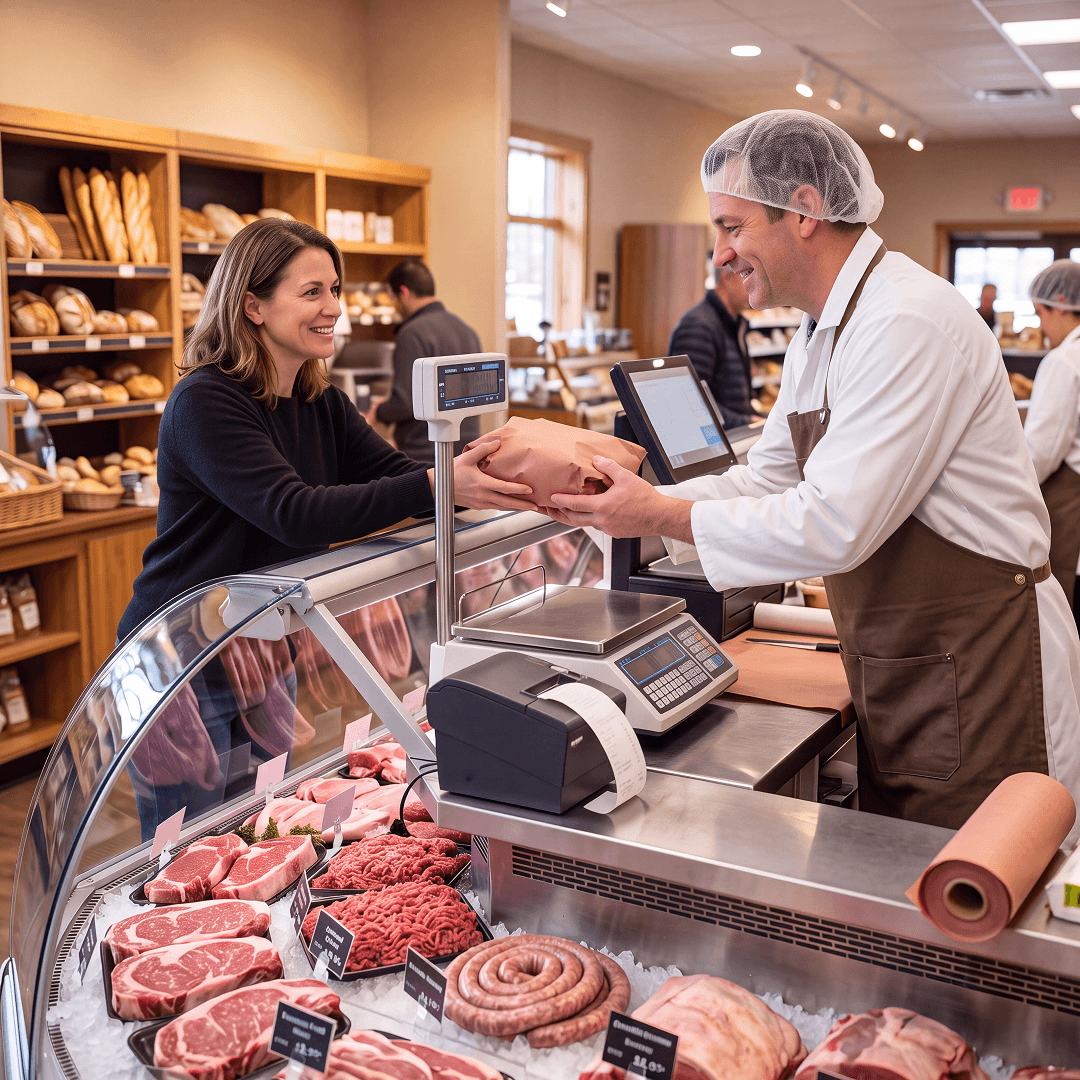
Specialty departments within grocery stores present unique operational challenges that require specialized POS capabilities. Butcher shops, bakeries, and prepared food departments handle variable-weight items, custom orders, and made-to-order production that standard retail POS systems struggle to accommodate.
Butcher shop operations demand POS systems that handle:
When integrated with e-commerce, these capabilities enable online ordering for custom cuts with accurate pricing. Customers can specify exactly what they want, and staff receive clear instructions for preparation.
Bakery departments and prepared food solutions require specialized capabilities including made-to-order customization, production scheduling based on order volume, ingredient tracking for allergen compliance, kitchen display systems for order management, and expiration-sensitive inventory requiring FIFO rotation.
Real-time POS integration ensures that online custom orders flow directly to kitchen displays, staff see order details without manual handoffs, and inventory adjusts automatically as orders are fulfilled.
The connection between POS and kitchen operations eliminates the communication gaps that cause order errors. When a customer orders a custom sandwich at the deli counter or through a self-service kiosk, that order immediately appears on the kitchen display with all specifications clearly visible.
Sophisticated inventory management software forms the backbone of unified grocery operations. Beyond basic stock tracking, modern platforms deliver predictive analytics, automated reordering, and cross-channel visibility that transforms how grocers manage their supply chain.
Real-Time Stock Tracking: Every transaction across every channel updates inventory counts immediately. Whether a sale occurs at the register, through the mobile app, at a self-service kiosk, or on a third-party marketplace, the system reflects accurate availability.
Predictive Analytics: AI-powered platforms analyze sales patterns, seasonal trends, and external factors to forecast demand. This enables proactive ordering rather than reactive scrambling when products run low.
Multi-Warehouse Management: For grocers with multiple locations, centralized inventory visibility prevents situations where one store sits on excess stock while another faces stockouts. Transfer recommendations optimize inventory distribution across the network.
Vendor Management: Integration with supplier systems automates purchase orders based on reorder points and lead times. Some platforms enable electronic data interchange (EDI) for seamless communication with major distributors.
Inventory accuracy depends entirely on data quality. Before implementing any integration:
This data cleanup typically requires 2-3 weeks for a single location but dramatically increases integration success rates.
Modern platforms extend inventory capabilities to mobile devices and tablets. Staff equipped with mobile applications can check stock levels without returning to a terminal, perform cycle counts with barcode scanning, receive and process deliveries in real-time, investigate price discrepancies instantly, and transfer products between departments or locations.
This mobility eliminates the information gaps that cause customer service failures and operational inefficiencies.
While multiple POS integration options exist, Local Express stands apart as an AI-powered unified commerce platform built specifically for food retailers competing against big retailers.
Unlike general retail platforms adapted for grocery, Local Express was designed from the ground up for the unique challenges food retailers face:
Local Express integrates AI throughout the platform:
Local Express integrates with major POS systems including NCR, Toshiba, and IT Retail, allowing grocers to keep existing hardware investments while gaining unified commerce capabilities.
Grocers implementing Local Express report measurable outcomes:
Beyond POS integration, Local Express provides branded e-commerce websites and mobile apps, self-ordering kiosk systems with kitchen display integration, last-mile delivery management with 100+ delivery network integrations, one-click marketplace launch to Instacart, DoorDash, and other platforms, and retail media capabilities for CPG advertising revenue.
For grocers serious about unifying their tech stack and competing effectively against big retailers, Local Express offers the comprehensive platform and dedicated support needed to transform operations. Request a demo to see how the platform addresses your specific requirements.
Real-time POS integration creates bidirectional data flow between your point-of-sale terminals and all connected systems—e-commerce platforms, inventory management, order fulfillment, and customer databases. When a transaction occurs, inventory updates across all channels within seconds. This matters because 56% of inventory records contain errors that cause order cancellations and lost sales. Real-time integration eliminates these gaps.
Local Express was built specifically for food retailers, with native support for perishable inventory tracking including expiration dates and FIFO/FEFO rotation, variable-weight pricing with certified scale integration for produce and deli items, complex fulfillment workflows for BOPIS, curbside, and delivery, and specialized department support for bakeries, butcher shops, and prepared foods. General retail platforms require extensive customization to handle these requirements.
Yes. Local Express integrates with major grocery systems including NCR, Toshiba, and IT Retail through pre-built connectors. This approach preserves your existing hardware investments while adding unified commerce capabilities, minimizing disruption and avoiding replacement costs.
Local Express delivers 164% average ROI with measurable outcomes including 95% reduction in oversell incidents, 30% increase in average basket size, and average savings of $36,320 annually per location through reduced shrinkage and labor optimization. Many grocers reach break-even within the first year.
Local Express integrates AI throughout the platform with AI Data Fusion that automatically harmonizes product data from multiple sources, predictive inventory analytics that forecast demand and optimize reorder points, AI-powered order management that accelerates fulfillment through intelligent picking routes, and AI Search capabilities that deliver contextual, multilingual results. These capabilities help grocers compete against big retailers with sophisticated technology.


