


.png)


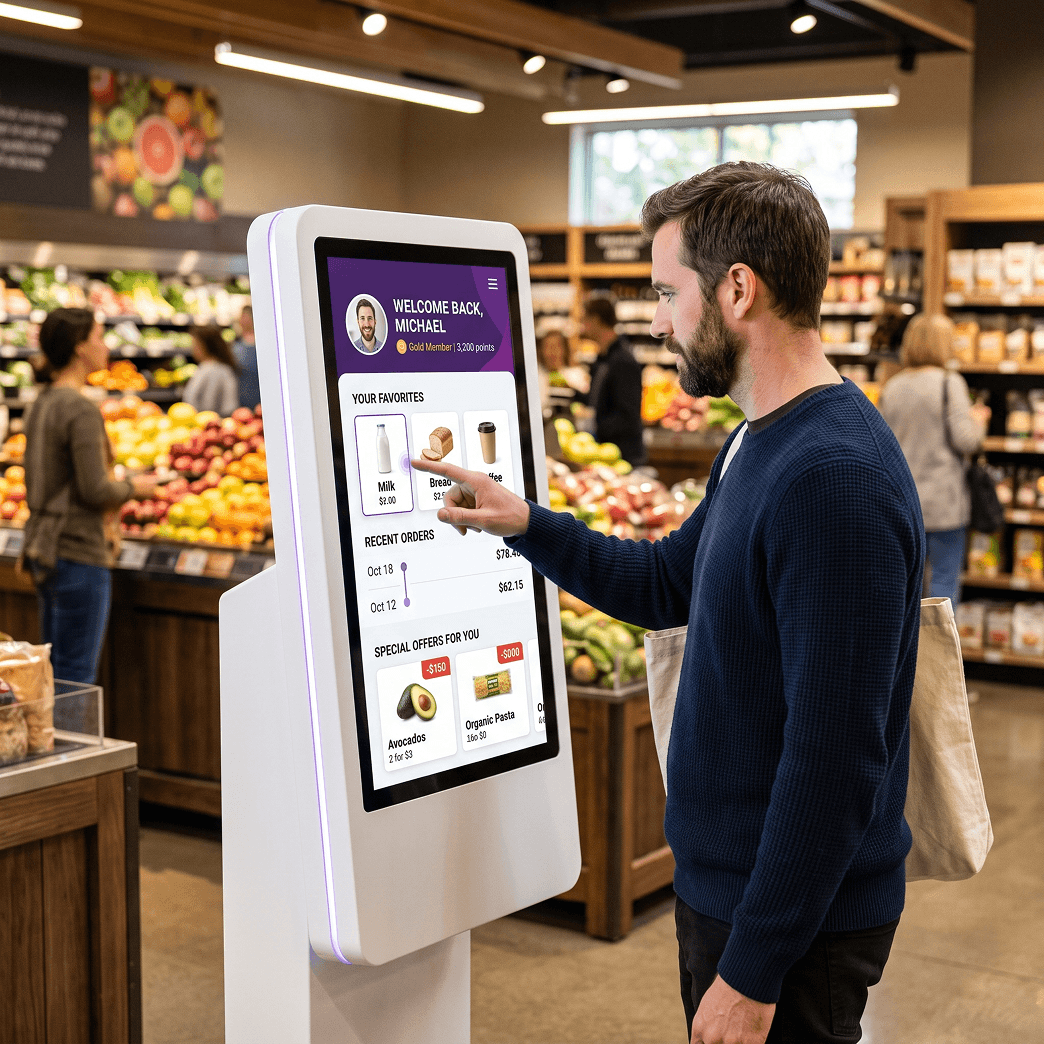



Your grocery store collects data on every transaction, every loyalty swipe, and every online order—yet most of that information sits fragmented across disconnected systems while big retailers like Amazon capture market share with seamless personalization. The solution lies in building unified customer profiles that connect web, app, kiosk, and in-store touchpoints into a single, actionable view. With omnichannel ecommerce solutions, grocers can bridge this gap and deliver the personalized experiences that turn one-time shoppers into lifetime customers.
A unified customer profile consolidates all shopper data—from POS transactions and loyalty cards to website visits, mobile app usage, and kiosk interactions—into a single comprehensive record. This foundation enables grocers to deliver personalized experiences while maintaining accurate inventory, pricing, and service data across every touchpoint.
Building effective unified profiles requires connecting multiple data streams:
The challenge for most grocers isn't collecting data—it's connecting it. Legacy systems often store customer information in silos, making it impossible to recognize that the shopper placing an online order is the same person who visits your store twice weekly. AI-powered data fusion solves this by harmonizing data from multiple sources and creating persistent customer identifiers that work across all channels.
For grocers managing multiple locations or expanding their digital presence, the complexity multiplies. Different POS versions, varying product catalogs across stores, and inconsistent data formats create barriers to unified commerce. AI-driven harmonization addresses these challenges by automatically matching products, normalizing attributes, and resolving identity conflicts across systems.
Effective integration requires three core capabilities:
Grocers implementing unified customer platforms must consider API architecture, data latency requirements, and fail-safe mechanisms. When a customer adds items to their cart on mobile, those selections should instantly appear if they switch to a kiosk or web browser. Similarly, loyalty point balances must update in real-time to prevent duplicate redemptions or customer frustration.
True omnichannel retail means customers experience your brand consistently whether they're browsing your website, shopping via mobile app, ordering at a self-serve kiosk, or walking your aisles. Unified customer profiles make this possible by ensuring every touchpoint has access to the same customer intelligence.
The revenue case for omnichannel is clear. Multi-channel shoppers spend $5,300 annually compared to $3,500 for those who only shop in-store. That $1,800 gap represents pure upside for grocers who can successfully connect their channels.
Synchronization enables powerful capabilities:
Industry platforms describe this as "embedded unified commerce"—where data harmonization happens automatically rather than requiring manual reconciliation. For grocers, this means promotions created in one system apply universally, customer preferences sync instantly, and staff can access complete purchase history regardless of where transactions occurred.
The technical implementation requires robust middleware capable of translating data formats between systems. When a customer applies a digital coupon online, the POS system must recognize and honor it for in-store pickup. Similarly, loyalty points earned in-store should immediately reflect in the mobile app balance.
Without unified profiles, omnichannel becomes a liability rather than an asset. Imagine a customer who receives a promotional email for 20% off their favorite coffee brand, adds it to their online cart, then decides to pick it up in-store—only to find the discount doesn't apply at checkout. These friction points erode trust and drive customers toward competitors who deliver seamless experiences.
Unified profiles eliminate these gaps by ensuring:
For grocery retailers competing against large e-commerce platforms, unified profiles level the playing field. Customers increasingly expect Amazon-like personalization and convenience from all retailers. Delivering that experience requires knowing each customer's preferences, purchase history, and shopping patterns regardless of which channel they choose.
Effective unified profiles capture the right data without becoming bloated or difficult to maintain. The key is designing templates that balance comprehensiveness with actionability.
Essential profile elements for grocery retail include:
Demographics and Contact Information
Behavioral Data
Transactional History
Loyalty and Engagement
Raw data becomes valuable only when transformed into actionable segments. Effective grocery customer data platforms enable:
Industry research on unified customer views recommends building use cases around specific business outcomes—like reducing churn or increasing basket size—rather than collecting data for its own sake.
Predictive segmentation helps grocers anticipate needs before customers express them. A customer who purchases baby formula every three weeks becomes a candidate for automated reorder reminders. Similarly, households that buy organic produce regularly can receive early alerts about new organic product arrivals or special promotions in that category.
The physical store remains central to grocery retail, but unified profiles transform what's possible within those four walls. When staff have access to customer intelligence, every interaction becomes an opportunity for personalized service.
Modern mobile applications extend unified profiles directly into the shopping experience:
Grocers implementing scan-and-go solutions report 60% customer adoption within three months, with 10% larger basket sizes because shoppers aren't self-editing to avoid checkout lines.
The in-store digital experience extends beyond checkout. Customers using mobile apps can scan items to view nutrition information, allergen warnings, and customer reviews. For grocers, this creates opportunities to surface complementary products and personalized recommendations based on purchase history.
Self-ordering kiosks play a crucial role in bridging digital and physical experiences. When a customer logs into a kiosk with their loyalty account, staff immediately access their purchase history, dietary preferences, and outstanding promotions. This transforms anonymous transactions into relationship-building moments.
The data flows both ways—kiosk interactions feed back into unified profiles, enriching customer understanding with insights about prepared food preferences, department engagement, and impulse purchase patterns. Over time, this intelligence enables highly targeted marketing and merchandising decisions.
Generic promotions waste money and annoy customers. Unified profiles enable the targeted, relevant marketing that 71% of consumers now expect from retailers.
Effective grocery personalization operates on multiple levels:
Purchase Cycle Triggers
Complementary Product Recommendations
Contextual Triggers
Retail media platforms take this further by enabling CPG brands to sponsor targeted promotions, creating new revenue streams for grocers while delivering relevant offers to shoppers.
Advanced marketing automation allows grocers to create sophisticated trigger campaigns. When a customer who typically purchases fresh salmon every week skips two consecutive weeks, the system can automatically send a targeted promotion to re-engage them. Similarly, customers who abandon online carts receive reminder emails with the exact items they left behind.
The metrics speak clearly: grocers who effectively activate their first-party data can achieve up to 30% higher retention rates compared to those who only collect it. The value of retention is clear; according to industry research, it can take up to 3.5 new customers to replace the value of a single lost long-term shopper.
Marketing effectiveness improves dramatically with unified profiles. Instead of batch-and-blast email campaigns with 2-3% engagement rates, personalized communications based on purchase behavior achieve 15-20% open rates and significantly higher conversion. The ability to segment customers based on actual behavior rather than demographic assumptions transforms marketing ROI.
Unified profiles don't just improve marketing—they transform operations. When order management systems connect to customer data, fulfillment becomes faster, more accurate, and more profitable.
Real-time inventory synchronization can materially improve order accuracy and reduce overselling and stockouts by keeping availability aligned across every channel. Every sale—whether in-store, online, mobile app, or kiosk—instantly decrements inventory across all channels.
Integrated inventory management with predictive AI enables:
AI-powered fulfillment systems can accelerate order processing by up to 50% through intelligent store mapping and optimized picking routes. For grocers managing high-volume online ordering, these efficiency gains directly impact labor costs and customer satisfaction.
Last-mile delivery management benefits directly from unified profiles. When systems know customer preferences—delivery windows, special instructions, contactless requirements—fulfillment teams can execute perfectly on first attempt. Grocers using AI-powered routing report estimated reductions of up to 30% in delivery costs.
Customer profiles inform fulfillment in subtle but important ways. A customer with gluten allergies receives extra attention during substitution decisions. Households with young children get fragile items packed carefully. These personalization touches, enabled by unified data, drive customer loyalty and reduce return rates.
Artificial intelligence transforms unified profiles from static databases into dynamic, predictive engines that anticipate customer needs before they're expressed.
Modern AI capabilities for grocery retail include:
AI agents now handle complex tasks that previously required manual effort. Catalog AI-Agent auto-enrich product data with titles, descriptions, and tags. Import AI-Agent map fields when integrating data from POS systems or spreadsheets. Analytics AI-Agents explain reports in plain language, making insights accessible to non-technical staff.
Machine learning models continuously improve as they process more transactions. A recommendation engine becomes more accurate over time, learning which product pairings drive the highest conversion rates for different customer segments. Similarly, churn prediction models refine their accuracy as they observe which interventions successfully retain at-risk customers.
The AI grocery data fusion module demonstrates how automation accelerates time-to-value. Instead of manually cleaning and mapping product data—which can take months for large catalogs—AI handles harmonization automatically, reducing store onboarding time from months to weeks.
For multi-location grocers, AI-powered data fusion solves the problem of inconsistent product catalogs across stores. The system automatically identifies that "Coca-Cola 12oz Can" at Store A is the same product as "Coke 12 oz can" at Store B, creating unified product records that enable consistent reporting and customer experiences.
The grocers thriving in today's market share one characteristic: they've built technology foundations that adapt as customer expectations evolve.
For example, research shows that retailers using unified POS systems report around 22% lower total cost of ownership compared to managing disconnected systems. This efficiency compounds over time as integrations multiply and data volumes grow.
Scalable platforms enable:
The grocery retail landscape continues evolving rapidly. Voice-activated shopping, autonomous delivery, and personalized nutrition coaching represent emerging channels that will require unified customer data. Grocers who build flexible, API-first architectures today position themselves to adopt these innovations without costly platform migrations.
Local Express stands apart as an AI-powered unified commerce platform purpose-built for food retailers. While generic retail platforms require extensive customization for grocery-specific needs—weighted items, fresh perimeter departments, EBT/SNAP compliance—Local Express delivers these capabilities out of the box.
Key advantages include:
Local Express's mission centers on bringing equality and accessibility to the online grocery market. The platform enables grocers to retain their brand identity while gaining the technology capabilities previously available only to major chains. With extended-hours technical support (all week, 5am–9pm PST) and quick setup timelines, grocers can go digital without massive IT investments.
The platform's AI-native architecture delivers continuous improvement. As grocers process more transactions, recommendation engines become more accurate, demand forecasting improves, and operational efficiency increases. This creates a compounding advantage—early adopters gain increasingly sophisticated capabilities without requiring constant manual optimization.
For grocers competing in markets dominated by large retailers with significant technology budgets, Local Express provides an equalizing platform. The same personalization, omnichannel capabilities, and operational intelligence that big retailers invest millions to build come standard with Local Express, delivered at a fraction of the cost and implementation time.
For grocers ready to unify their customer data and compete effectively in the digital marketplace, Local Express provides the comprehensive, AI-native platform that connects every touchpoint into a seamless customer experience.
A unified customer profile consolidates all shopper data—from in-store purchases, online orders, mobile app usage, loyalty programs, and kiosk interactions—into a single comprehensive record. This enables grocers to deliver personalized experiences across all touchpoints while maintaining accurate inventory and pricing data. The business case is compelling: multi-channel shoppers spend $1,800 more annually than single-channel customers.
Local Express delivers 4-8 week implementation timelines through AI-powered data fusion and pre-built grocery integrations. The platform automatically harmonizes product data from POS systems, eliminating months of manual catalog mapping. One-click integrations with major POS systems (NCR, Toshiba, IT Retail) and purpose-built grocery features mean no extensive customization is required, unlike generic retail platforms.
Yes, modern unified commerce platforms integrate with major POS systems through REST API connections. Real-time synchronization ensures inventory updates across all channels instantly. Implementation typically requires 2-8 weeks for API integration, depending on complexity, with material improvements in order accuracy as the result.
Enterprise platforms implement multiple security layers: TLS 1.2+ encryption for data in transit, AES-256 encryption for data at rest, role-based access controls, and comprehensive audit trails. Compliance frameworks include GDPR, CCPA, and PCI DSS compliance for payment security. For grocery-specific requirements, platforms support USDA/FNS SNAP Online Purchasing requirements (where eligible and approved, using compliant processors/hardware) and age-restricted item validation.
Unified profiles ensure customers experience consistent pricing, promotions, and service regardless of channel. Cart persistence means items added on mobile appear at kiosk checkout. Loyalty points accrue and redeem across all touchpoints. Grocers who effectively activate their first-party data can achieve up to 30% higher retention rates compared to those with disconnected systems.


