


.png)


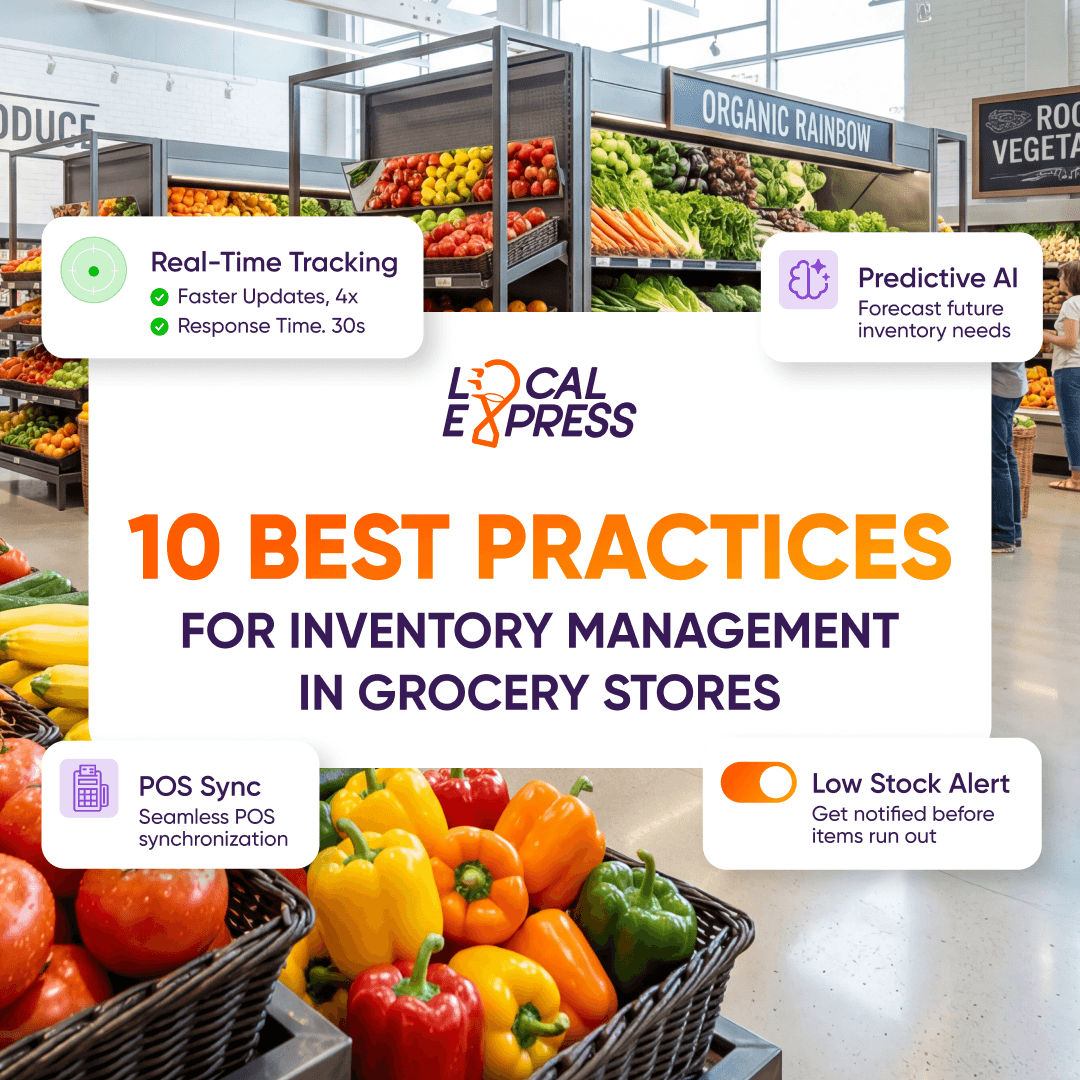



Operating a grocery store on a 1.6% average profit margin leaves no room for inventory mistakes. Yet most grocers lose up to 8% of revenue through poor inventory availability—five times their entire profit margin. The solution lies in adopting modern inventory management solutions that combine real-time tracking, AI-powered forecasting, and seamless POS integration to transform waste into profit.
Effective grocery inventory management balances the constant tension between product availability and waste minimization. Unlike other retail sectors, grocers must account for perishability, expiration dates, and the complex interplay between fresh items requiring just-in-time replenishment and shelf-stable products that can be ordered for efficiency.
Understanding these fundamentals helps grocers identify where inventory breakdowns occur and prioritize improvement efforts for maximum financial impact. Research shows that 58% of retailers operate below 80% inventory accuracy, creating a cascade of problems from stockouts to excessive waste.
The transition from manual spreadsheets to sophisticated inventory management systems represents the single most impactful change grocers can make. Modern platforms eliminate the guesswork and inefficiency that plague traditional inventory methods.
The Local Express platform delivers these capabilities through seamless POS integration and predictive AI that maintains optimal stock levels while preventing overselling across channels. Implementation typically takes only a few weeks, with dedicated support ensuring a smooth transition that minimizes operational disruption.
Fresh product management separates successful grocers from those struggling with waste and stockouts. 31.3% of retail surplus food comes from fresh produce, representing both environmental waste and lost profits.
Real-time visibility enables proactive management before problems escalate:
The Local Express AI Data Fusion module turns raw inventory data into clean, actionable insights. The platform maintains real-time inventory accuracy through continuous synchronization with POS systems and provides low stock alerts that prevent both stockouts and overordering.
Standardizing inventory processes through templates ensures consistency regardless of which staff member handles tasks. Effective templates capture essential information while remaining simple enough for consistent daily use:
Grocers using mobile counting apps reduce manual inventory time by 73%—from 30 hours monthly to just 8 hours—while improving accuracy. Best practices include training all staff on template usage and continuously refining templates based on real-world feedback.
Beyond software platforms, specific hardware and mobile tools dramatically improve inventory accuracy and reduce labor requirements. Modern grocers integrate diverse technologies into cohesive systems that enhance rather than complicate workflows.
The Local Express platform supports barcode scanners and Zebra devices alongside mobile and iPad apps for inventory management. The unified eCommerce platform synchronizes product information across website, mobile app, and in-store kiosks. When inventory updates in one location, the change reflects instantly across all channels—eliminating the overselling that frustrates customers.
Inventory management extends beyond the store to encompass the entire supply chain from vendor to customer. End-to-end visibility reveals inefficiencies and opportunities that remain hidden when focusing solely on in-store stock.
Strong vendor partnerships improve inventory performance through lead time accuracy, quality consistency, promotional coordination, and clear communication protocols. Research reveals that 70-90% of stockouts result from internal replenishment failures rather than actual supplier issues, making internal process improvements essential.
The Local Express Last Mile Delivery solution enhances supply chain efficiency by cutting delivery costs up to 30%. The platform supports in-house fleets, third-party couriers, or hybrid setups—all managed from one centralized dashboard with AI-powered routing.
Additionally, the Order Processing System accelerates fulfillment by 50% through AI-powered store mapping that organizes collection by aisle, department, or zones. This streamlined approach reduces picking time while maintaining accuracy across multiple concurrent orders.
The grocery industry is experiencing rapid AI adoption, with 89% of retailers actively implementing or assessing AI solutions. This transformation addresses the accuracy and forecasting challenges that have historically plagued grocery inventory management.
AI algorithms analyze patterns across millions of transactions to identify insights invisible to human observation:
Local Express operates as an AI-Powered Unified Platform specifically designed for food retailers. The platform brings together e-commerce, POS, inventory management, and analytics into a single solution that eliminates the integration headaches common when cobbling together multiple point solutions.
The Omnichannel Ecommerce Solutions synchronize in-store and online inventory in real-time, preventing the overselling that damages customer relationships. Grocers using the platform achieve 98% inventory accuracy while maintaining seamless availability across websites, mobile apps, and physical stores—all managed from a centralized dashboard.
The point-of-sale system serves as the transaction hub where inventory theory meets reality. Every sale, return, and price override should automatically update inventory records—yet many grocers still operate with disconnected systems that require manual reconciliation.
Seamless integration eliminates the gaps that create inventory inaccuracy:
Only 35% of grocers have adopted automation solutions, creating significant competitive disadvantage. The Local Express platform offers 1-click POS synchronization that eliminates price inconsistencies and prevents stock discrepancies across channels. The system integrates with major POS providers including NCR, Toshiba, and IT Retail, allowing grocers to maintain their existing hardware while gaining enterprise-grade inventory capabilities.
The Self-Ordering Kiosk Systems further demonstrate this integration strength by seamlessly connecting with POS systems for unified retail solutions. Transactions processed through kiosks, mobile apps, or traditional registers all update the same real-time inventory, ensuring accuracy regardless of transaction source.
After mastering fundamental inventory practices, successful grocers implement advanced strategies that further optimize stock levels, reduce waste, and improve profitability.
Just-in-time (JIT) inventory minimizes holding costs by receiving products only as needed for immediate sale. This approach proves particularly valuable for highly perishable items with short shelf lives. However, JIT requires reliable suppliers, accurate demand forecasting, and buffer stock for unexpected demand spikes.
ABC analysis categorizes inventory based on value contribution:
This segmentation allows grocers to focus detailed attention where it matters most while managing lower-value items through automated reorder systems.
Additional strategies include vendor managed inventory (VMI) where suppliers monitor and replenish their products directly, cross-docking to move products from receiving to delivery without storage, perpetual inventory for continuous counting of high-value items, and cycle counting for regular partial counts that maintain accuracy without closing operations.
The Local Express Order Processing System supports these advanced strategies through flexible fulfillment options including pickup, curbside, and home delivery. The platform's AI-powered product substitution capabilities ensure customer satisfaction even when implementing tighter inventory controls that occasionally create temporary unavailability.
Modern inventory systems deliver 300-400% ROI within 12 months, with payback periods as short as 6 months. Grocers implementing AI-powered fresh inventory management see ROI within 90 days through waste reduction alone. The financial impact stems from reducing the up to 8% of revenue typically lost to poor inventory availability. Local Express platform implementation typically takes only a few weeks, allowing grocers to begin capturing benefits almost immediately.
AI-powered inventory systems achieve 98% accuracy compared to around 63% for traditional methods—a 35-percentage-point improvement. AI analyzes patterns across millions of transactions to predict demand with 80%+ accuracy versus around 60% for traditional forecasting. The technology accounts for variables like day-of-week patterns, weather, local events, and seasonality that manual methods struggle to incorporate consistently.
Yes—unified commerce platforms like Local Express make enterprise-grade inventory capabilities accessible to grocers without massive IT investments. While only 35% of grocers currently use automation solutions, cloud-based platforms eliminate the infrastructure costs that previously created barriers. Implementation takes just a few weeks, and the platform provides 24/7 technical support. The key advantage is getting a complete unified system—e-commerce, POS integration, inventory management, and analytics—rather than attempting to integrate multiple point solutions.
Seamless POS integration serves as the foundation for inventory accuracy by ensuring every transaction automatically updates stock levels without manual intervention. POS integration eliminates price inconsistencies, prevents overselling across channels, and provides complete transaction audit trails. The Local Express platform's 1-click POS synchronization works with major providers including NCR, Toshiba, and IT Retail to deliver these benefits without requiring system replacement.
AI-powered fresh inventory management reduces losses by up to 40% through real-time monitoring, automated markdown recommendations, and demand forecasting that accounts for day-level patterns and external factors. Key strategies include FIFO rotation enforcement, expiration date tracking with automated alerts, and day-level forecasting that reveals patterns like doubled demand before holidays. Given that 31.3% of retail surplus food comes from fresh produce, and U.S. supermarkets lose an estimated $15 billion annually in unsold fruits and vegetables, fresh optimization represents the highest-value inventory improvement opportunity.


